Rooms of Resonance
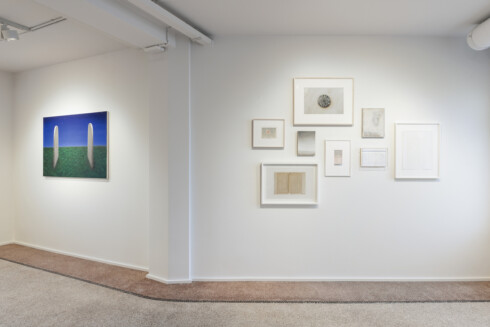
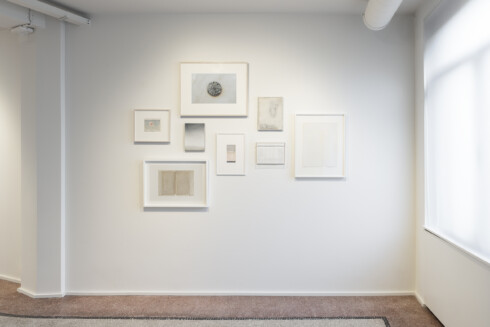
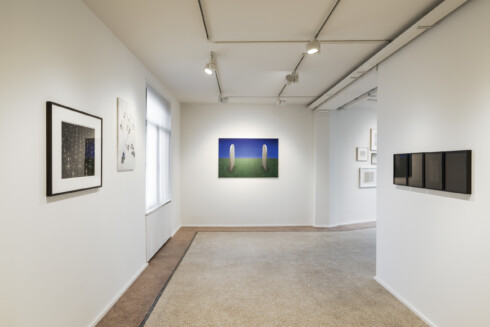
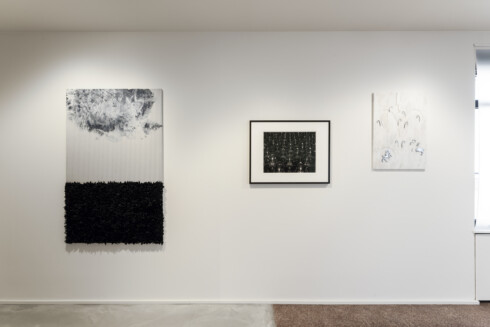
Curators Benedicte Goesaert and Chantal Pattyn selected about 60 artworks unfolding from the sensuality of earthly matters to the exploration of metaphysical energies.
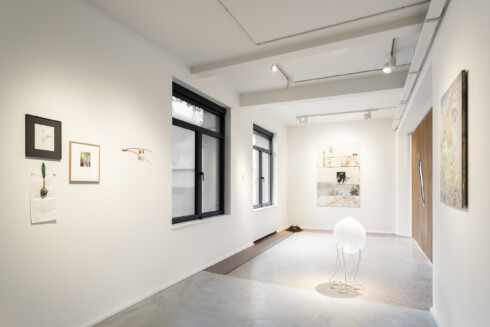
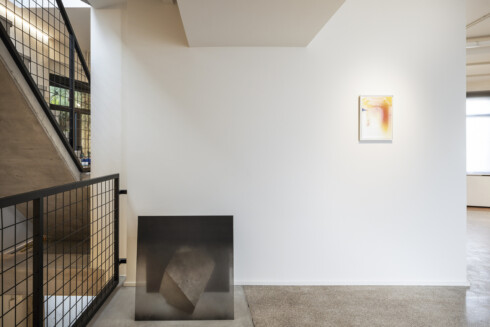
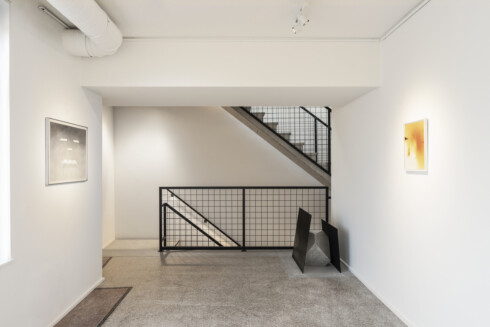
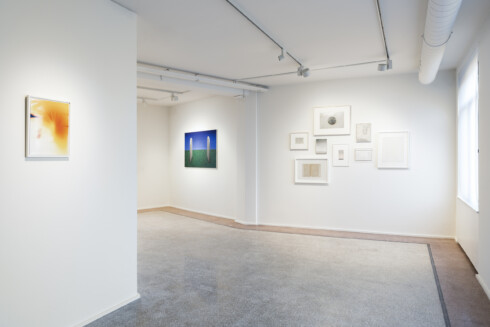
Exhibition views © Hugard & Vanoverschelde.
Introduction
For the second exhibition since the launch of Cloud Seven, and third exhibition in the building, private collector Frédéric de Goldschmidt presents Rooms of Resonance, curated by Benedicte Goesaert and Chantal Pattyn. In order to conceive the show, the curators travelled through the collection with the ambition to present works that hadn’t been part of an earlier presentation. This was the start of a journey about connecting with specific pieces of artists known to them and investigating the work of emerging and less familiar artists. The concept unfolded during different stages of editing the selection and interacting in conversations with the collector about relationships between the works. This process resulted in the selection of 62 artworks by 54 artists on view. Rooms of Resonance celebrates beauty and life and examines how to connect with oneself, others and the world in these disruptive times. The journey unfolds through four different stages, from the sensuality of earthly matters to the exploration of metaphysical energy.
A celebration of life and beauty
Rooms of Resonance celebrates life and beauty, while questioning how to connect with the self, the other and the world in these disruptive times. Through stages of pleasure, discomfort, regeneration and contemplation, Rooms of Resonance is conceived as an upward movement that starts from the body and gradually journeys into a transformative mental process.
The exhibition’s title was inspired by the work of German sociologist Hartmut Rosa (Resonance, a Sociology for the relation to the World, Polity Press, 2021). Rosa developed his resonance theory as an alternative to the alienation of materialism. Resonance can be achieved when we are driven by empathy, compassion and understanding.
The note from the curators
The title of the exhibition is inspired by the thinking of the German sociologist Hartmut Rosa (Resonance, a Sociology for the relationship to the World, Polity Press, 2019). Hartmut Rosa is convinced that it is the kind of relationship to the world that defines the quality of life. Herewith he values the mode of being in the world higher than the impact of the availability of options and resources as a condition for a successful relationship to the world. Etymologically, the word ‘resonance’ comes from the verb ‘to resound’, and refers to the specific relationship between two bodies when the vibration of one body stimulates the other to produce in turn its own frequency.
Rooms of Resonance is a journey that can be different every time you walk through it: perhaps your company has changed, your feet walk a different path or the weather is sunny or rainy that day. Each room in the exhibition is a vessel that holds different kinds of resonance between the artworks themselves. However, another kind of resonance is possible the moment you enter each room. Here, your questions are vital: where and how do you find resonance with what you see? What happens if you don’t experience such resonance? Rosa describes a full spectrum of ways, from physical and emotional to cognitive, to establish our relationship with the world. Rooms of Resonance is conceived as an upward movement that starts from the body to gradually depict a mental process. It starts from the exploration of one’s true self and embracing one’s own way of being. Discomfort, regeneration and transformation can then help us reach contemplation and get a sense of metaphysical energy.
The selected works tell us something about how Frédéric de Goldschmidt and the curators relate to the world. More importantly, we invite you to enter the exhibition and reflect on your own relationships with a more heightened consciousness. Feel free to decide how you walk through the exhibition. We recommend that you absorb the atmosphere in each room and only start reading when you first take a moment to look from your own perspective. In this way you can investigate where you see points of resonance between works following your own thoughts or emotions. It will be more surprising to later find out if your observations are aligned with the voice of the curators and artists. Keep in mind there is an infinity of possibilities in reading and interpreting a work of art. The title Rooms of Resonance highlights the intimate and semi-private spatial context of Cloud Seven. Every room brings together a particular selection of artworks that are curated following a connecting theme.
54 artists
Adriano Amaral, Joël Andrianomearisoa, Gabriele Beveridge, Cecilia Bjartmar Hylta, Mohamed Bourouissa, Lucia Bru, Giorgio Andreotta Calò, James Castle, Mathew Cerletty, Julian Charrière, Clément Cogitore, Laurent Da Sylva, N. Dash, Jacqueline De Jong, Michael Dean, Svenja Deininger, Edith Dekyndt, Daniel Dewar & Grégory Gicquel, Fernanda Fragateiro, João Gabriel, Alexis Gautier & Max Pinckers, Dimitar Genchev, Nadia Guerroui, Camille Henrot, Hudinilson Jr., Krištof Kintera, Maria Kley, Ícaro Lira, Ella Littwitz, George Henry Longly, Luciana Magno, Gohar Martirosyan, Rachel Monosov, Michèle Morgan, Musa N. Nxumalo, Gabriel Orozco, Richard Prince, Laure Prouvost, Louis-Cyprien Rials, Ry Rocklen, Ed Ruscha, Anri Sala, Tomás Saraceno, Raja Babu Sharma, Lucie Stahl, Daniel Steegmann Mangrané, Hiroshi Sugimoto, Ayesha Sultana, Jirō Takamatsu, Wolfgang Tillmans, Cléo Totti, Margo Wolowiec, Trevor Yeung, Yunyao Zhang.
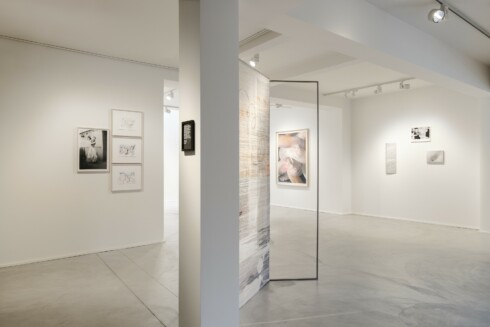
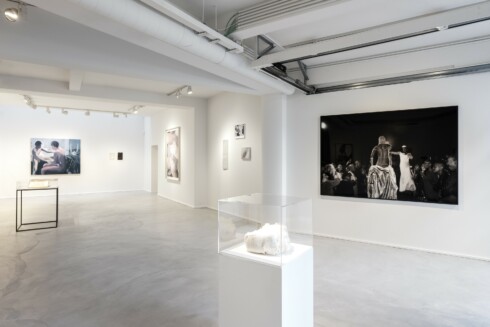
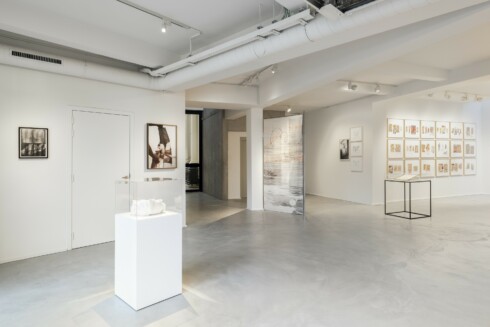
Ground Floor – Bodily Sensations
This room reflects upon the presence and representation of a variety of human bodies and how they relate. Through different shapes, materials, textures and techniques, possible relationships towards a body or between bodies are explored. The resonance can be emotional, sexual or sensual in nature, or it can relate to memory and fantasy, sometimes depending on the mechanism of the gaze.
What is the relation to your body?
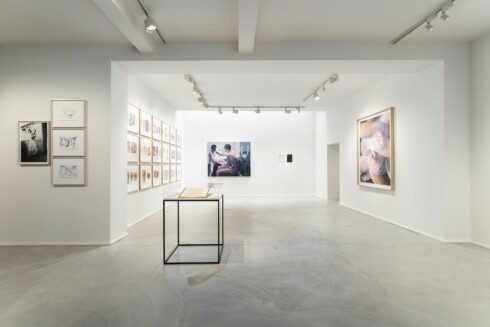
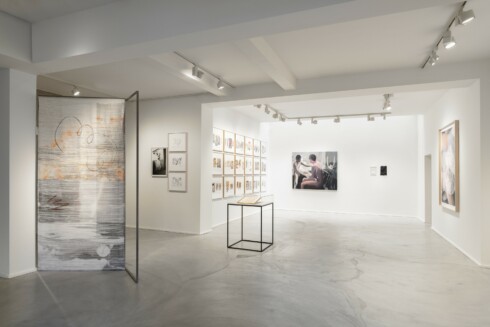
10! 10! 10! 10! by Musa Nxumalo and the painting by João Gabriel depict naked bodies ready to be seen or to connect with others. Nxumalo photographed vogueing dancers at a queer event in Johannesburg. By incorporating the audience in the image, Nxumalo blurs the lines between gaze and display. In a similar fashion, João Gabriel transformed the imagery of 70s/80s gay porn into an intimate, poetic painting in soft pink and purple tones. Love between Humans by Cléo Totti and Mirror Study by Paul Mpagi Sepuya show body fragments: the beginning and end of one’s body is not clear. Here, new bodies unite.
In several works in this room, the body is absent. What is left is the memory of a body as in the folded ceramic shirts by Ry Rocklen, or Commuter, a drawing by N. Dash which results from folding and touching paper with her own hands. Washing by Wolfgang Tillmans shows a beautiful and intimate composition of white un...
A close-up of a belly button is drawn on felt by Zhang Yunyao. It’s a spot not everyone pays attention to, but reminds us about the connection with our mother.
The exhibition is proud to have one ‘special’ mother represented. The pink collage of a topless woman represents France Roche, Frédéric de Goldschmidt’s mother, and it was made by Michèle Morgan, the leading lady in many French films.
In Together Richard Prince added pictures of naked male and female body parts to fictional drawings by Willem de Kooning. These collages are surreal and critical, and at the same time an obsessive reflection of desires and fantasies.
With Tropics of Love, Camille Henrot adds exoticism as a grotesque and even guilty version of the fantasy of the other. Tropic of love is inspired by the role the Polynesian dancer plays in the Western imagination.
Two bodies touching each other closely is a scene drawn beautifully in Embracing Couple by Salvador Dali, from the collection of Frédéric de Goldschmidt’s father.
All of these bodily memories and expressions are driven by a vibrant energy as in Spring Fever by Margo Wolowiec and the poem La boutique à rêves by Joël Andrianomearisoa.
First Floor – Crash
Systems are crashing. Sometimes they must because they are not sustainable anymore. All kinds of crises have an impact on our own wiring system. How can we protect ourselves before, during and after the crash? What mental and technological strategies will protect us from undesired pressure?
How resilient are you?
A framed picture shows masked rebels gathered around a fire pit. They protest to cause problems for international and political governments in favor of a better future. The masks in Clément Cogitore’s We are legion refers to the main character in V for Vendetta, a film based on the Guy Fawkes story in the early 17th century, and later appropriated by the hacktivism group ‘Anonymous’. What they have in common is a desire to fight corruption and oppression by the establishment.
It also refers to the history of painting and to the famous Déjeuner sur l’herbe (1863) by Edouard Manet. Romanticism and naturalism merge in a scene that triggers contrasting senses of danger, relaxation and communality. Is this the moment before or after an impactful event?
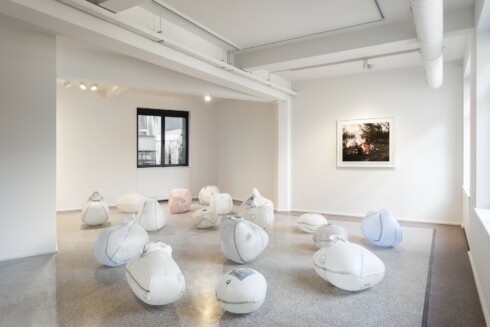
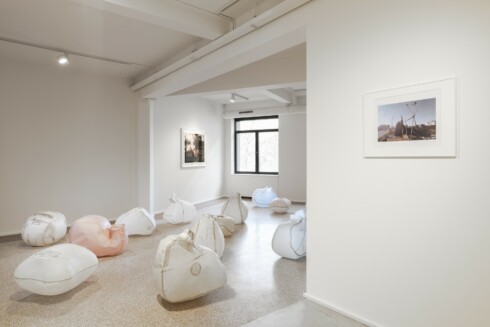
...Inflated airbags are spread over the floor, disconnected from the car where they belonged. Calculation of Incoherence by Cecilia Hylta Bjartmar reminds us of a crash and the moment where technology seems to care for us and explodes to protect the human body. The artist deals with a balance between vulnerability and power.
With Nervus Vagus and Difficulties with understanding, Krištof Kintera questions the function of internal wiring structures that run through our body and brain. Feelings of satiety and pain run through it. When we experience a crash in our system, we try to understandand fix it, but what happens when we have to accept our own limits?
Second Floor – Regeneration
This room reflects on the relationship between nature and human beings. Nature nurtures existence and shows the power of adaptation, transformation and regeneration. To quote Rosa: ‘where our relationship to the world begins to breathe’.
Do you feel the vibes in this room?
The Mourning Beekeeper by Alexis Gautier and Max Pinckers shows a beehive covered in a black veil, honoring a tradition carried out in Lancashire. After the death of a beekeeper, the family invites the bees to participate in the mourning process. Everything within the life of the beekeeper, from birth to death and any changes in the household like the arrival of visitors, have to be conveyed to the bees. If the bees were not informed, all hell would break loose in the hives. These superstitions were built upon the belief that beekeepers and their hives had a strong emotional bond, and so should be informed with the same courtesy extended to a family member.
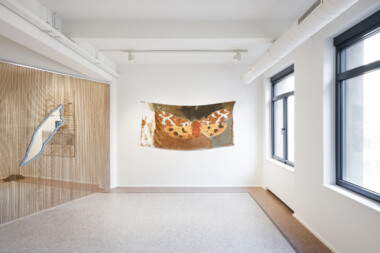
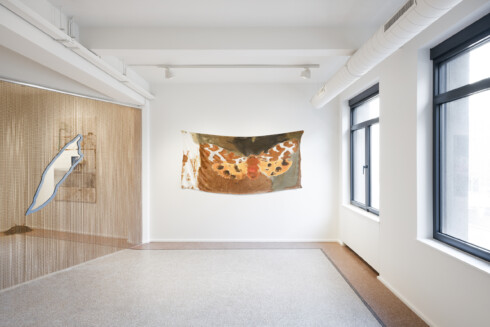
...Once it was a small caterpillar, often unnoticed, but the Arctia caja, or garden tiger moth, now spreads its colorful and beautiful wings on a large piece of silk by Daniel Dewar & Grégory Gicquel. A real caterpillar will turn into a moth during the course of the exhibition: out of the three cocoons in Icarus (ramo), by Giorgio Andreotta Calò, two are microcasted in silver but one, an Argema Mimosaeis is alive. It is attached to the sculpture with a thread and will be replaced after the birth of the first chrysalis.
Other intriguing creatures in the animal realm are spiders. Tomàs Saraceno collaborates with them for his hanging organic sculptures. The title of this work reads: Hybrid Dark Semi-Social Choreography HD 186791 Built by: a solo Cyrtophora citricola one week. The web —super strong and resilient— is considered an extension of the spider’s sensorial and cognitive systems.
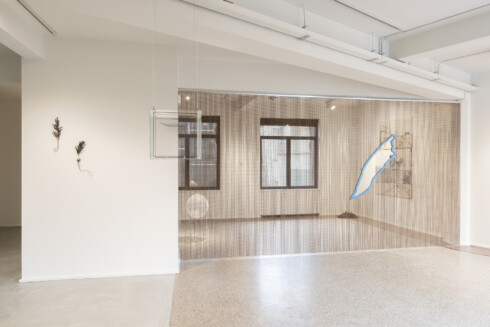
Ruderal plants cast in bronze by Ella Littwitz grow over a wall and remind us that, even in war zones, plants find ways to grow through cracks of damaged surfaces.
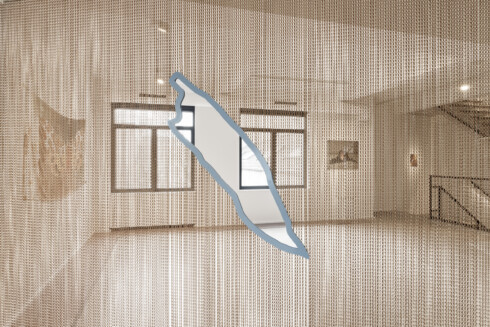
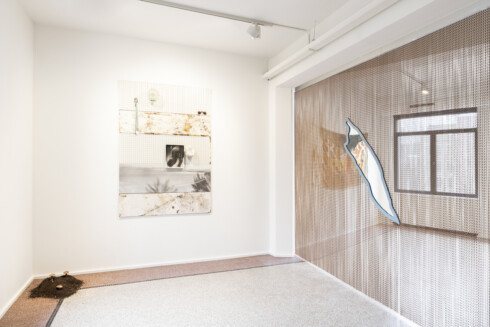
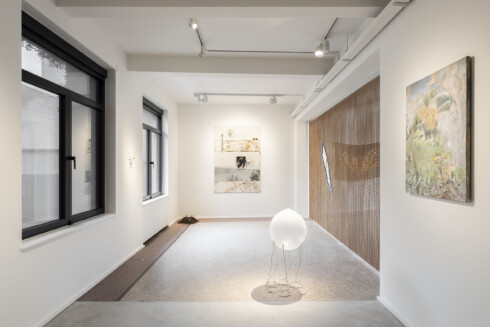
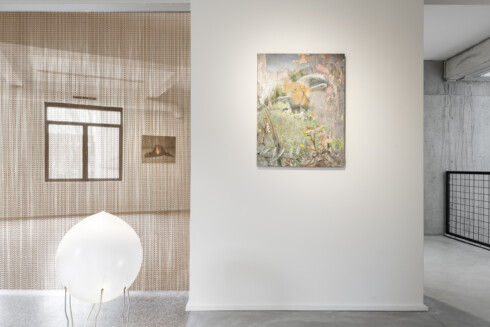
Walking through the metal curtain by Daniel Steegmann Mangrané, you become aware again of your own body.
Another arresting title is I’d Tell You if I Knew by Gabriele Beveridge. In the moment of reshaping, transforming and regenerating, it is at times impossible to explain what is going on and where it will lead. The composition of individual elements in this installation suggests a reconfiguration, but also an openness for other possible variations. All the experiences in life become part of it and can feel like a collage. They are related but yet very much separated entities.
The sculpture Collective Effort by Rachel Monosov comes with a specific instruction: Care for the object by inflating and sustaining the balloon with your breath. When filling the balloon with air, think of all you want to release from your body. Carefully place the balloon into the brass hands and they will hold your burden.
This can be an individual process, but never underestimate the power of collective care which is reflected in the sculpture where many hands hold a balloon into the air.
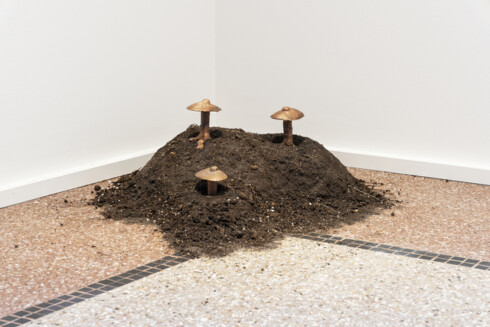
Looking closer to a place where wall and floor meets, an installation of night lamps in the shape of mushrooms get activated when the lights go down, inviting the viewer to day dream…
Third Floor – Transcendence
The journey upwards continues as a room for contemplation becomes visible. The human body is no longer represented, but still remains present. A process of transcendence took place. The lack of recognizable images invites closer observation. An open mindset and internal conversation helps to discover what is being triggered and what kind of resonance is experienced.
Are you open to the liberation of all mental limitations? How is your breathing?
The vivid and radiant detonation of Wolfgang Tillmans’ 260 Spiel transports us into a suspended moment in time. Tillmans delves deeply into the technical possibilities of photography and has a strong compass for close observations of human life and its surroundings....
Opposite, Ed Ruscha’s Four Sheets levitate against a background made with gunpowder. Integrating unconventional materials, the artist creates an extraordinary quality of grey.
Laurent Da Sylva places a polyhedron of concrete and ashes between two square plates. The artist offers a moment of contemplation and reflection, as the stone refers to the one that Albrecht Durer depicted in his famous print, Melancholia (1514).
Light, which warmly embraced us in Nadia Guerroui’s textile work, finds new poetic expression in Giorgio Andreotta Calò’s cut-out Polaroid, whose title alludes to a Latin verse attributed to Virgil: ‘We whirl around in the night, and we are consumed by fire’.
Gabriel Orozco’s Another Shower Head, with its corroded orifices, reminds us about a sentiment of relief when water comes out and cleans the body.
Fernanda Fragateiro photographed the paper cover that was protecting a copy of Carlos Fuentes’ novel Aura (1962) that was given to her by an exboyfriend 30 years ago. This representation of aged paper carries a memory of love and care.
In the works of Edith Dekyndt, Jirō Takamatsu and Sultana Ayesha, the meditative repetition of the artist’s gesture, like an anchor, inscribes our lives and the passage of time into the paper. As a daily exercice during her pregnancy, she counted each of her breaths by marking them with a scratch on clay coated paper. It was her way of dealing with a chronic lung condition and entering a meditative space, a moment ‘when the mind calms down and the heart opens’.
Astral worlds open up in marble, painting and textile with the works of Matthew Cerletty, George Henry Longly and Joël Andrianomearisoa. The exhibition also reaches a deeper level of connection with beauty, joie de vivre and vibrating energies with a small work by Raja Babu Sharma belonging to a series of tantric designs.
A seemingly endless array of identical Boddhisattva statues, photographed by Hiroshi Sugimoto in the extraordinary temple Sanjusangen-do (Hall of Thirty-Three Bays, Kyoto) offers us a glimpse of what eternity could look like.
Stay in the loop.
Events and exhibitions straight to your inbox.
By clicking send, you will receive occasional emails from Cloud Seven. You always have the choice to unsubscribe.