Is That All There Is?
This is a question many people ask when standing in front of a work of art: am I missing something, or is there more to see?
Sometimes, the answer is straightforward. The work is complete in itself. Its material, its form, its presence are enough. In other cases, something seems to be missing, or it appears as part of an ongoing process or a more complex narrative. The question can also extend beyond the object itself, touching on the limits of human existence.
Curated by Frédéric de Goldschmidt and Grégory Lang.
Exhibition views © Hugard & Vanoverschelde.
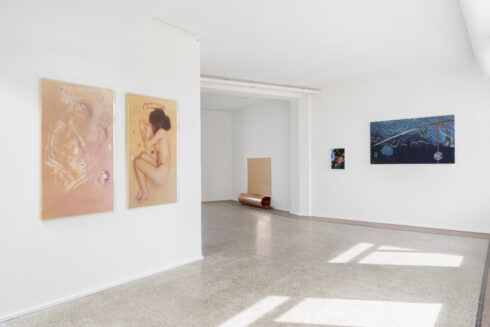
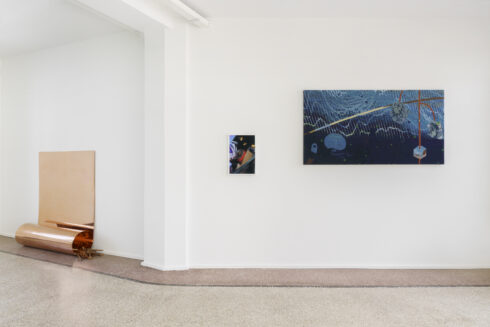
For this exhibition, Frédéric de Goldschmidt and Grégory Lang have brought together a selection by more than 50 artists from the collection, each offering a different response to this question. Some works are fully present; others point to what is partial or evolving, or confront the idea that there may — or may not — be anything beyond.
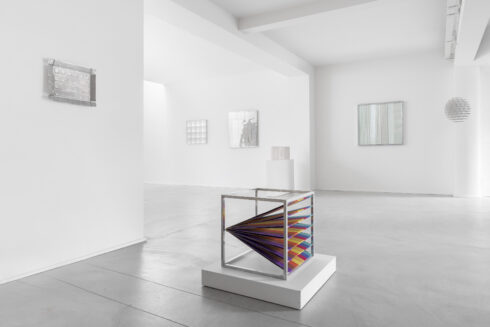
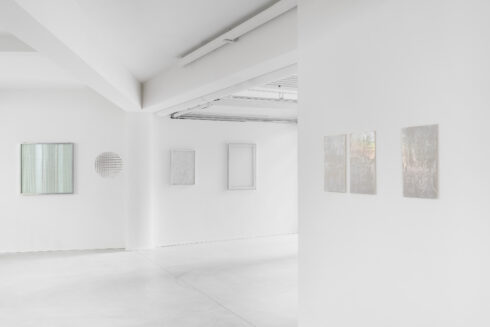
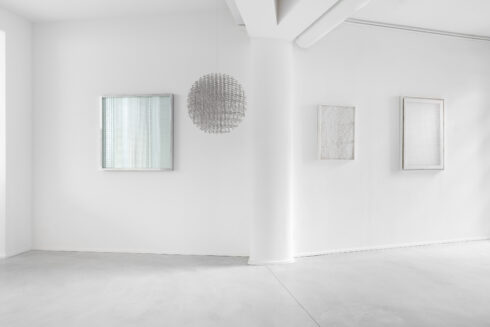
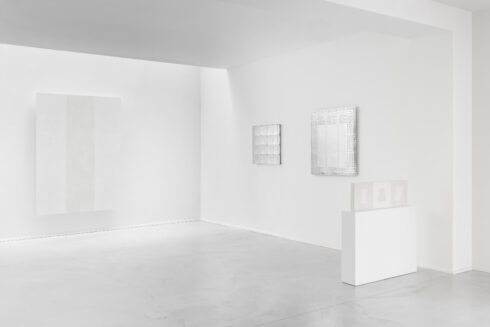
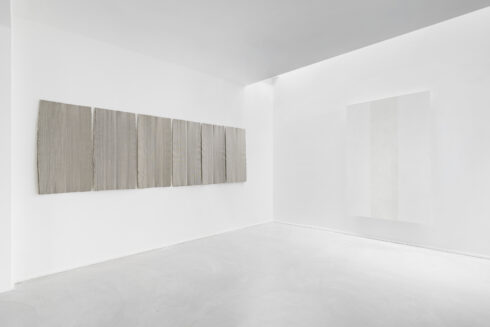
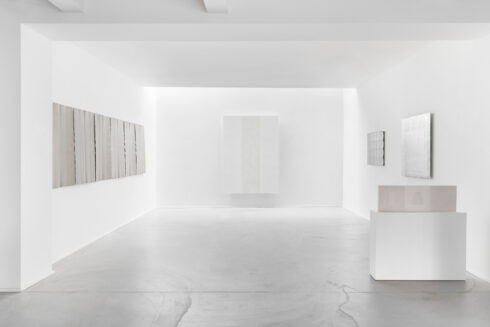
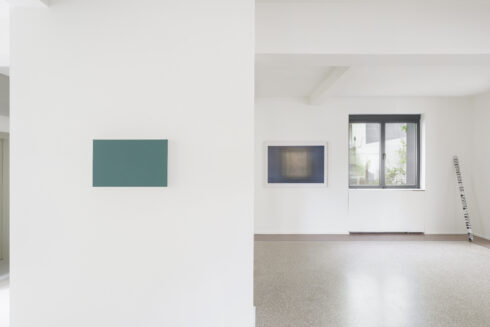
On the ground floor, the focus is on minimal and geometric forms. The visual experience — rhythm, repetition, vibration — is sufficient in itself. Nothing needs to be explained or added. This is evident in the way light interacts with the surface of a reflective painting by Mary Corse, refracts across glass panels and mirrors by Nanda Vigo, or changes when the viewer moves in front of three works by Nadia Guerroui.
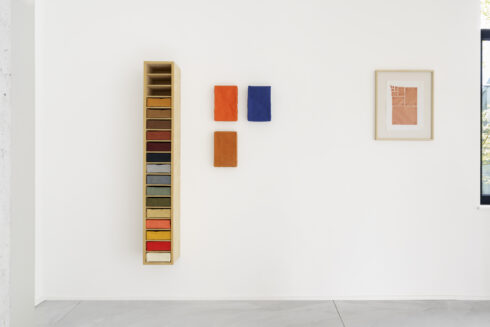
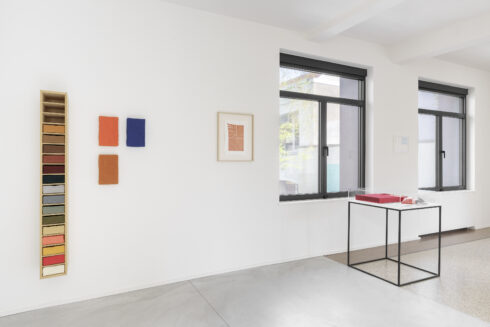
On the next two floors, what is shown may be a score, a fragment, a trace, or a stage within a larger process. An apparently monochrome painting by Ignasi Aballí or color patches assembled by Abraham Cruzvillegas, may hold a meaning that only the title reveals, both engaging with forms of indexing shared by many artists in the exhibition.
A half-filled aquarium by Anne Marie Maes evolves over time, as bacteria slowly transform its contents. A gesture may have already taken place, as in a sheet of paper hand-cut into diminishing pieces by Alighiero Boetti, or simply folded and carried in the back pocket of Kate Owens. Works by Franz Erhard Walter and Germaine Kruip only fully exist when activated by the viewer.
The question also extends beyond the works themselves and points to limits. The resources of our planet are not endless, as reflected in Otobong Nkanga’s woven work inspired by marine debris, or in Luciana Magno’s video showing an act of resistance along the Trans-Amazonian route. All forms of life and matter eventually decay and transform — whether in the domestic plant of Alicja Kwade or the cast iron body of Antony Gormley. An abstract evocation of the entrance to Paradise by Tacita Dean may, perhaps, offer a form of solace.
Is that all there is?
If that’s all there is, my friends, then let’s keep dancing
Let’s break out the booze and have a ball
If that’s all there is
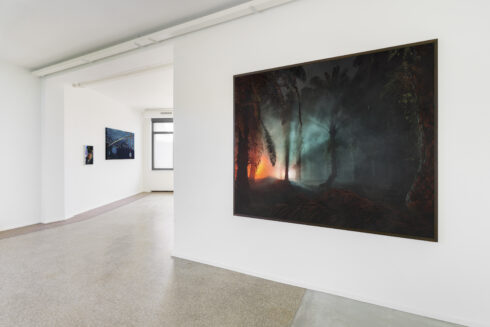
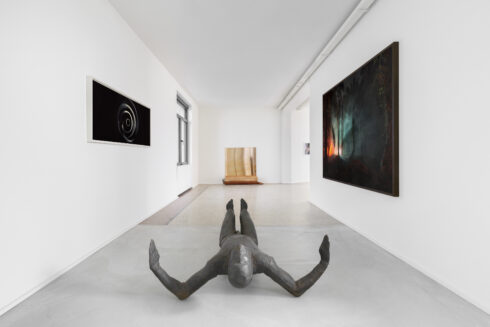
Echoing the chorus of the song popularized by Peggy Lee, the exhibition concludes with a photograph by Julian Charrière of multicolored lights from a dystopian rave in a deserted palm oil plantation, alongside a bottle of gin by Joël Andrianomearisoa lying on the floor.
The exhibition reflects various facets of the collector’s vision, from his early interest in Minimal art and Arte Povera — with sculptures by Sol LeWitt, François Morellet and Alighiero Boetti,, and artists associated with the ZERO group such as Adolf Luther and Piero Manzoni — to key contemporary figures such as Antony Gormley, Tacita Dean, Rachel Whiteread, and Alicja Kwade.
It brings together a wide range of media, including large-scale photographs by Boris Mikhailov and Martin Désilets, videos by Guillaume Barth and Luciana Magno, and a work by Will Kerr using augmented reality.
The artists represented span multiple geographies, from Latin America (Abraham Cruzvillegas, Oscar Santillán, Gabriel Chaile) to Japan (Hideyuki Ishibashi) and South Africa (Bronwyn Katz).
The exhibition is dedicated to the memory of Jean-François Boclé (1971–2026), a dear friend of the collector, who passed away a few days after his performance at the closing of Cloud Seven’s previous exhibition. Is That All There Is? presents the outcome of two of his performances, reflecting on the role of banana plantations — and exploitation — in his native Martinique.
55 artists
Adolf Luther, François Morellet, Sol LeWitt, Dadamaino, Marthe Wéry, Roman Opalka, Piero Manzoni, Nanda Vigo, Boris Mikhaïlov, Franz Erhard Walther, Jacqueline de Jong, Alighiero Boetti, Claudio Parmiggiani, Mary Corse, Hamish Fulton, Antony Gormley, David Wojnarowicz, Anne Marie Maes, Roni Horn, Ignasi Aballí, Stefana McClure, Gabriel Orozco, Rachel Whiteread, Tacita Dean, Nicolas Kozakis, Abraham Cruzvillegas, Jonathan Monk, Martin Désilets, Germaine Kruip, Jean-François Boclé, Joël Andrianomearisoa, Darren Harvey-Regan, Otobong Nkanga, Will Kerr, Alejandro Cesarco, Hotel Charleroi, Katinka Bock, Michail Pirgelis, Benjamin Sabatier, Kapwani Kiwanga, Alicja Kwade, Kate Owens, Oscar Santillán, Daniel Turner, Gabriel Chaile, Guillaume Barth, Hideyuki Ishibashi, Julian Charrière, Kirill Savchenkov, Luciana Magno, Nadia Guerroui, Orso Caël, Nicolas Faubert, Thomas Van Reghem, Bronwyn Katz.
Ground Floor
On the ground floor, the focus is on minimal and geometric forms. The visual experience—rhythm, repetition, vibration—is sufficient in itself. Nothing needs to be explained or added.
This is evident first in the monochrome white car painting by Nicolas Kozakis at the entrance. This minimalist intention is further revealed in how light interacts with the subtle, reflective surfaces of works by Nadia Guerroui and Mary Corse. Perception shifts as the viewer moves, a characteristic also found in François Morellet’s Sphere-Trame (1962), which casts evolving shadows, and in Nanda Vigo’s glass surfaces.
Vigo, a member of the avant-garde Group Zero (1950–60)—a cornerstone of this collection—dialogues with an iconic Achrome (1961) by Piero Manzoni. Her shiny Cronotopo (1963) contrasts with the satin plastic layers of the 1960 stretchers by Dadamaino, the group’s other prominent female figure....
The matte texture of Sol LeWitt’s delicate recto-verso relief offers another contrast to the square, mirrored “readymades” by Michael Pirgelis and Adolf Luther. It also resonates with the handmade paper ensemble by Marthe Wéry on the left. Wéry’s series of sober, irregular vertical lines was notably featured at Documenta 6 in Kassel (1977). Centrally placed, Mary Corse’s Untitled (White Inner Band, Beveled) investigates materiality and perception. Like LeWitt, she uses a minimalist language, employing precisely geometric painting and glass panels that refract light according to the viewer’s movement through the space. Finally, visitors are invited to rediscover Alighiero Boetti’s colorful sculpture Zig Zag (1966), which plays with reflections on its metal structure. This piece was a highlight of the exhibition Inaspettatamente and appeared on the cover of Full House, the book published on this occasion.. As Boetti’s final work before leaving the Arte Povera movement—another pillar of the collection—this found object stands in conversation with a silver cast of simple cardboard by Rachel Whiteread.
First Floor
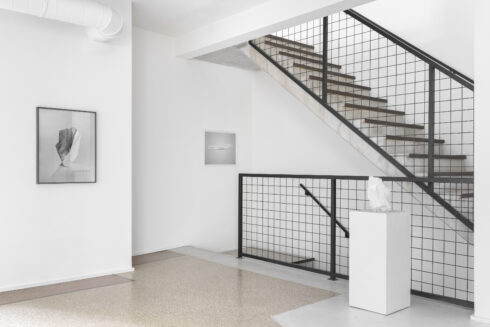
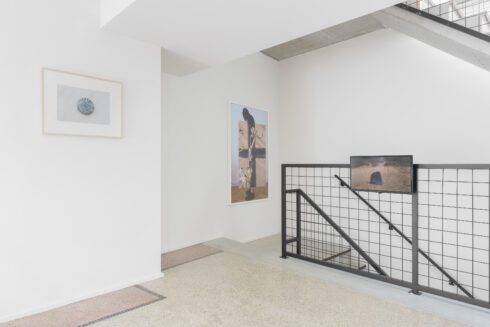
As one goes up the stairs, the text in Alejandro Cesarco’s photograph marks a transition from sensory perception to a more conceptual approach, where artists gather, collect, and index, and where fragments stand for the whole.
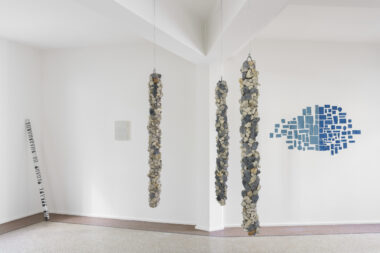
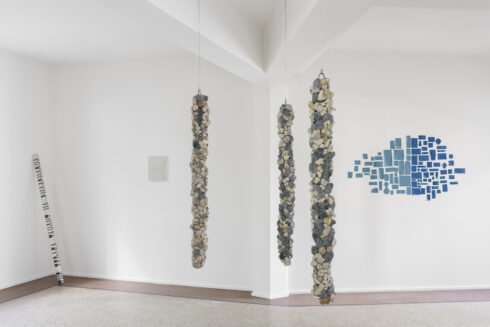
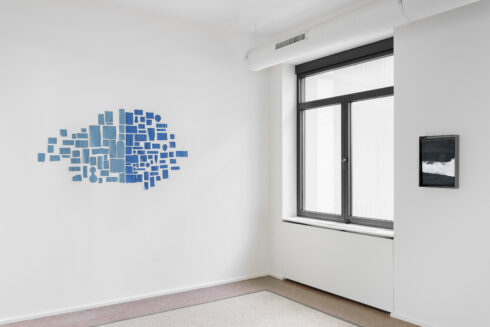
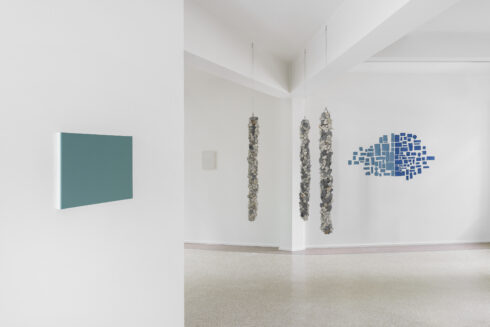
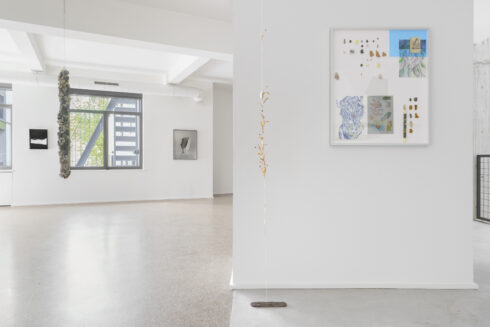
In the center of the room hang three long metal nets filled with pebbles. On the back wall, an arrangement of small pieces of paper painted in two shades of blue. The titles offer an entry point: Below the Barbès bridge for the sculptural assemblage by Bronwyn Katz, and Blind self portrait… for the work by Abraham Cruzvillegas.
The pebbles gathered by the South African artist were not collected on a beach, but under the arches of the elevated metro in Paris, near a station where many African immigrant workers gather, evoking displacement and discrimination. By contrast, Cruzvillegas refers to a moment in his life in Mexico — with food, music, and friends. Each piece of paper comes from his everyday life, forming an accumulation of experience....
Two rectangular works should attract your attention: one green, the other in shades of purple and green. The first derives from the average color of a still from Jeanne Dielman, 23 quai du Commerce, 1080 Bruxelles by Chantal Akerman. Translated into paint, the monochrome surface somehow retains the presence of Delphine Seyrig. Black Matter, State 28 by Martin Désilets results from the compression of 2,800 artworks photographed in museums around the world. A small work by Stefania McClure contains all the subtitles of The Umbrellas of Cherbourg. Nearby, a black-and-white diptych condenses the lights of Paris and its suburbs, captured over 45 minutes from a moving car. Without the titles, much of what these works contain would remain invisible. This floor is also about fragments: the first verse of a poem by Roni Horn, or the sequence of numbers by Roman Opalka, part of his lifelong project of writing numbers from 1 to infinity. The sheet shown here spans from 3,170,185 to 3,173,104. A work by Will Kerr appears incomplete: a folded canvas that can be virtually unfolded via a chip, revealing both the gesture and the scenery that inspired the gesture…
Second Floor
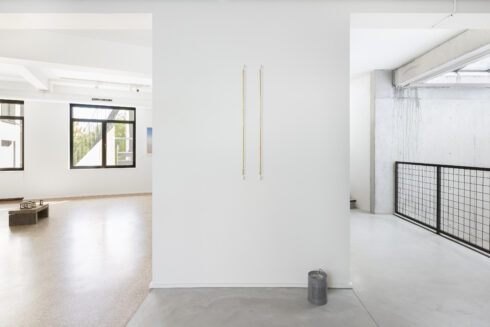
All the works on this floor share a common thread: they represent specific steps or phases of a larger, performative process.
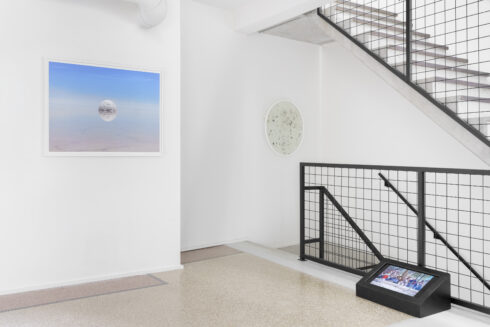
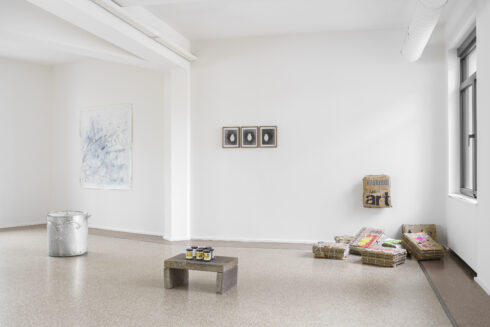
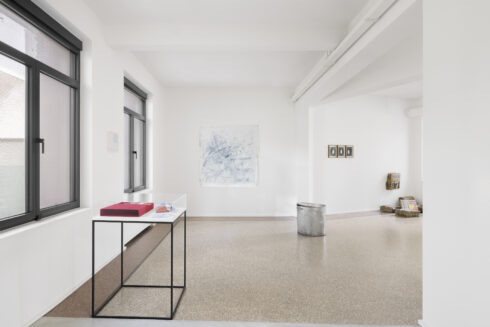
This is first seen in Éparpillés, a tondo by Thomas Van Reghem created from the residues of a political performance held on the frozen border between Finland and Russia. Similarly, Guillaume Barth’s photograph Elina (2015) documents an ephemeral sculpture installed on the Bolivian Salt Flats in accordance with cycle of rain and local traditions, while his video Elina 2015–2025: La promesse aux Aymaras (2025) captures his return and the public presentation of his publication ten years later. Political themes also drive the wooden installation by the Hôtel Charleroi collective, which repurposes furniture from Art Brussels, and the archaeological project of Hideyuki Ishibashi. Ishibashi’s cyanotypes of grenades are made using black ash from the Japanese kilns where these wartime ceramics were rediscovered. Gabriel Chaile’s aluminum pot functions similarly, serving as the “leftover” of a social action supporting indigenous communities in Argentina. The biological process defines the half-filled aquarium by Anne Marie Maes, which evolves as bacteria slowly transform its content —producing a new work during the exhibition.
The ensemble by Jean-François Boclé stems from an early performance using banana packaging—symbols of colonialism and the ecological destruction caused by the insecticide Chlordecone. In a later culinary performance, he transformed the fruit into political marmalade....
In contrast, the more intimate work of Hamish Fulton poetically symbolizes a long walk through Nepal, acting as a record of a personal performance —much like the prints of traces left after a dance by Nicolas Faubert. A gesture may have already occurred, as seen in the fabric folded and carried in the back pocket of Kate Owens, or in a sheet of paper hand-cut into diminishing pieces by Alighiero Boetti.
Ultimately, works by Benjamin Sabatier and Jonathan Monk are protocols with instructions, while those by Franz Erhard Walter and Germaine Kruip only fully exist when activated by the viewer.
Third Floor
The question also extends beyond the works themselves and points to limits. The resources of our planet are not endless, as reflected in Otobong Nkanga’s woven work inspired by marine debris, or in Luciana Magno’s video showing an act of resistance along the Trans-Amazonian route. All forms of life and matter eventually decay and transform — despite attempts to preserve them, whether in Alicja Kwade’s copper-cast domestic plant or Jacqueline de Jong’s shriveled potato turned into a gold jewel.
“Is that all there is?
If that’s all there is, my friends, then let’s keep dancing
Let’s break out the booze and have a ball
If that’s all there is”
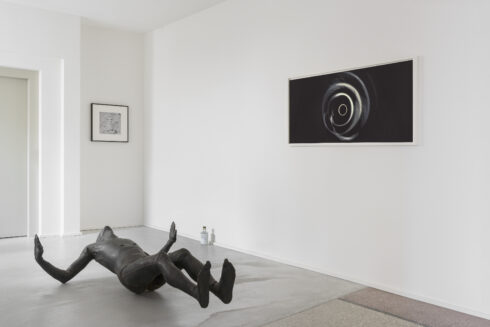
Echoing the chorus of the song popularized by Peggy Lee, the exhibition concludes with a photograph by Julian Charrière of multicolored lights from a dystopian rave in a deserted palm oil plantation, alongside a bottle of gin by Joël Andrianomearisoa lying on the floor....
In this context, the cast body of Antony Gormley can be read in different ways, from vulnerability to ecstasy. The exhibition closes with the iconic self-portrait by Peter Wojnarowicz, his face emerging from dirt as he was dying of AIDS. An abstract evocation of the entrance to Paradise by Tacita Dean may, perhaps, offer a form of solace.
Stay in the loop.
Events and exhibitions straight to your inbox.
By clicking send, you will receive occasional emails from Cloud Seven. You always have the choice to unsubscribe.