Casual/Tease
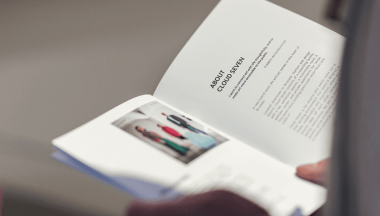
The Memorial for Those Who Did Not Fall in War, a nomadic lab developed by Columbia University’s Global Center for Peace Innovation, arrives in Brussels with Casual/Tease.
Curated by Hadas Zahavi, founder of the Columbia Global Center for Peace Innovation.
Photos © Anatole Mélot.
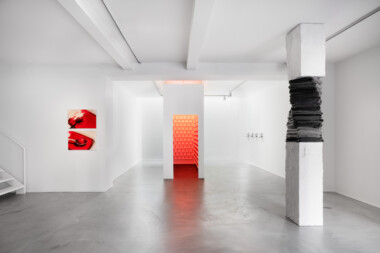
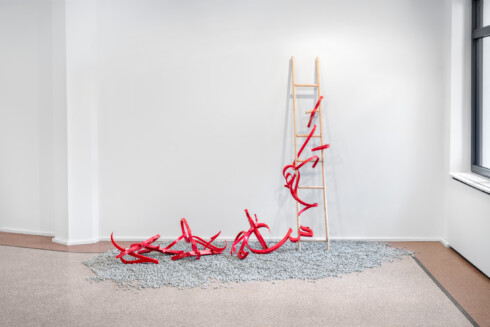
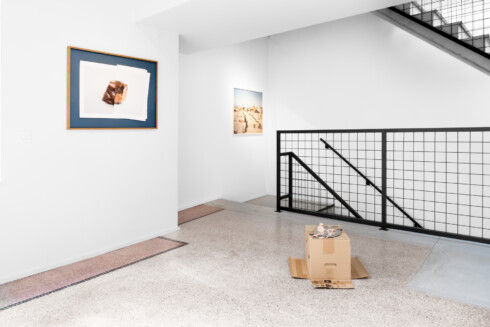
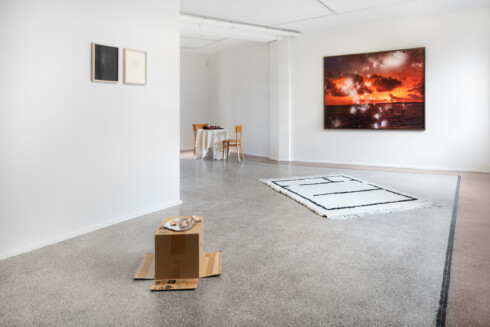
We think we know what harm looks like. From breaking news to social media, we are saturated with a constant stream of images of victims set against collapsed facades, darkened walls, dust hanging in the air, and streets brought to a halt under rubble. In this flow of images, we learn where to look for casualty and, just as crucially, where not to: within the uninterrupted course of day-to-day routine. Casual/Tease lingers exactly where nothing seems to happen, within the casual continuity of everyday life: a quiet view from a window onto a flowering boulevard, a household ladder leaning within reach, a handmade ceramic vessel ready to hold a bouquet. Each work in Casual/Tease first appears as a small, innocent fragment of daily life, caught in a fleeting moment of ease. Look a little longer, however, and that ease begins to fracture. The window view borrows the gaze of a military drone; the ladder becomes the impossible reach for food amid genocide; the delicate vessel reveals the form of a grenade, handmade in wartime Japan. To look here, then, is not simply to uncover what was hidden, but to confront what perception itself has been trained to overlook.
What comes into view is a dispersed field of implication in which neither injury nor agency remains confined to the site of war. First, the works bring us face to face with those who produce its casualties from spaces that still carry the appearance of casual life: from bright university laboratories associated with human progress where technologies of warfare take shape, through spacious offices where their production is financed and their sale negotiated, along everyday routes of commerce where weapons move among the ordinary flow of goods, to the safe distance from which armies deploy remote warfare technologies, preserving the appearance of everyday life here while bringing it to a halt elsewhere. The exhibition extends this encounter, too, to those who live with war’s casualties in places where everyday life appears to have resumed: walking across poisoned ground, breathing contaminated air, inhabiting landscapes scattered with the remnants of past wars, and living among materials in which military violence quietly persists long after the moment of impact has disappeared from view. In holding these two ends of the same continuum together, Casual/Tease resists the structures that bind them, reaching toward another kind of casual reality; one that leaves no casualties in its wake.
Artists:
Reza Aramesh, Julieta Aranda, Kader Attia, Nina Berman, Julian Charrière, Baptist Coelho, Detex, Kendell Geers, Shilpa Gupta, Dan Halter, Majd Abdel Hamid, Mona Hatoum, Hideyuki Ishibashi, Benoît Jacquemin, Will Kerr, Lesia Khomenko, Kapwani Kiwanga, Daria Koltsova, Vera Kox, Anton Kusters, Rachel Labastie, Emilio López-Menchero, Edgar Martins, Ismail Matar, Aimé Mpane & Jean Pierre Müller, Pratchaya Phinthong, Walid Raad, Shareef Sarhan, Omid Shirazi, Laure Tixier, Danh Vō, Meltem Yildiz, Mohammad Zaza, Zgjim Zyba
Ground Floor
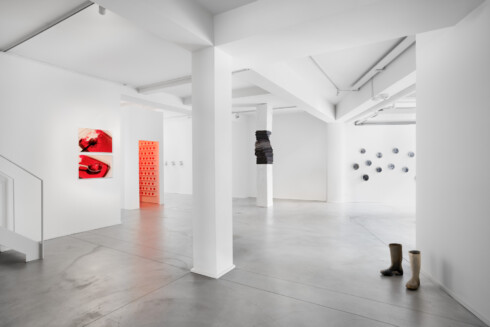
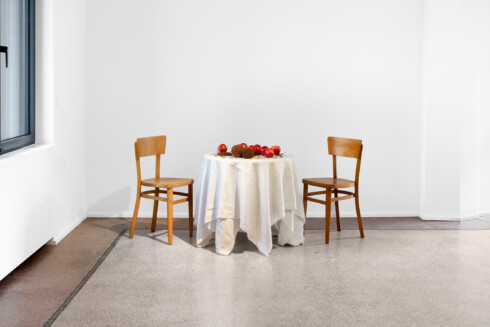
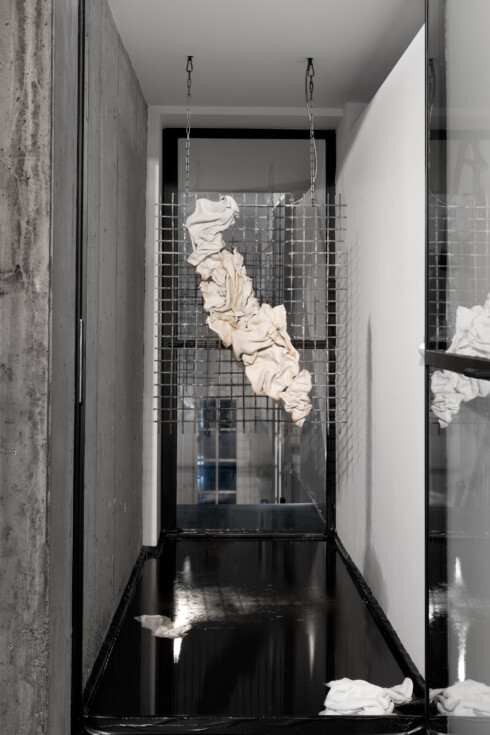
The exhibition begins on the ground, where casualty enters ordinary life at its most intimate, asking the things we cover ourselves with, eat from, wear, hold and share to carry what cannot yet be put into words. In Zgjim Zyba’s FROM ALL THE PLACES THEY ARE FROM, aid blankets that remained in Kosovo homes after the genocide and were absorbed into domestic life are gathered into a single suspended form, giving material presence to a past that has often remained unspoken. Omid Shirazi’s It’s Just Jelly, Babe. Want Some? turns to the seductive surface of an instant commodity to hold what systematic violence and censorship in Iran leave impossible to show directly. In Shilpa Gupta’s Blame, created after the 2002 burning of a train carrying Hindu passengers in Gujarat and the subsequent attacks on Muslims, the artist distributed small bottles of simulated blood labelled “Blame” on Mumbai trains like cheap merchandise. On Shareef Sarhan’s Concrete Remembers, photographs of Gaza’s fishermen preserve the sea, labour and everyday life within the space of the shared meal, holding open an image of a Palestine whose liberation is still to come. The domestic becomes a provisional archive, holding histories whose meanings are still being made.
First Floor
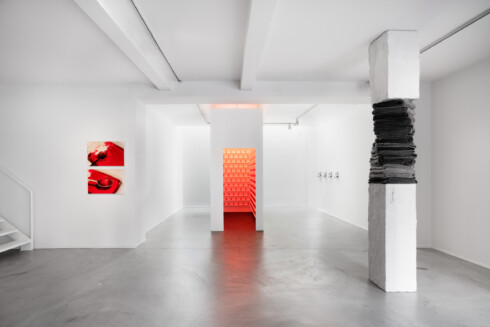
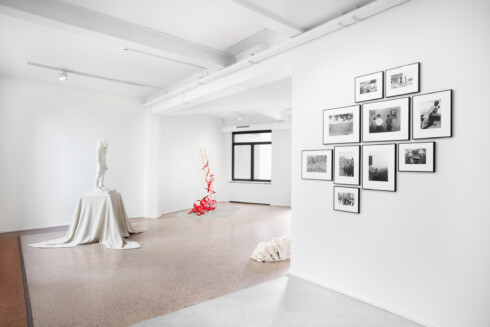
The first floor moves from the objects through which violence persists to the forms of perception through which it fails to become visible, in the first place. Reza Aramesh begins with a casualty already made visible by the news, but only for the duration of an image: by removing an anonymous figure from that circulation and carving him in Carrara marble, he gives a body destined to disappear with the next image the permanence historically reserved for monuments. With Edgar Martins, even that possibility of representation begins to fail: his investigation into the disappearance and death of photojournalist Anton Hammerl in Libya leaves the photographic image undeveloped, holding it at the same threshold of uncertainty as a casualty whose place of death cannot be conclusively located. From images that circulate too quickly to a photograph that never fully appears, casualty is altered by the very forms in which we try to see, name and remember it.
Second Floor
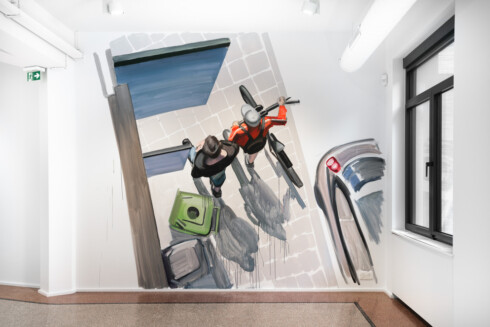
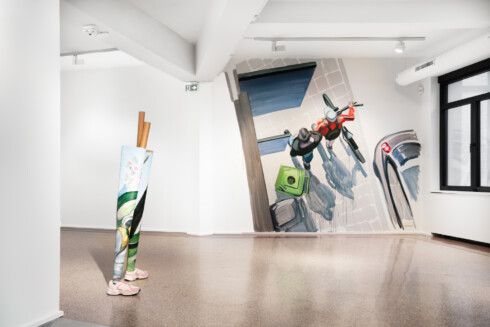
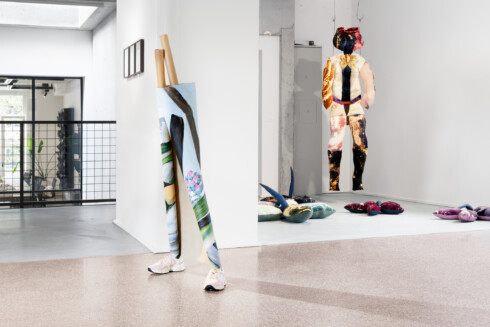
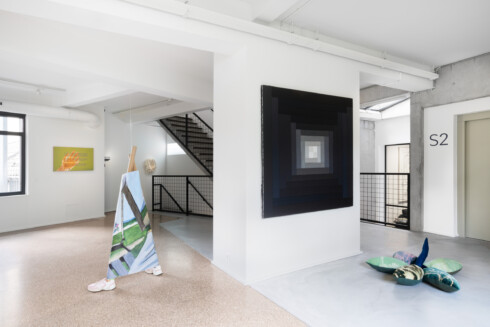
On the second floor, representation turns toward the ways we look and are looked at in relation to casualty: as potential targets or as responsible for its production. Lesia Khomenko begins with the most immediate possible view: the flowering boulevard visible from the windows of Cloud Seven. Reconstructed according to the visual conventions of drone imagery, the familiar Brussels street is suddenly seen from above, and the apparently innocent act of looking out of a window approaches the weaponised gaze of surveillance and targeting. Anton Kusters reverses that vertical axis. Standing on the last known locations of 1,078 former Nazi concentration camps and killing centres, he points his camera upward, producing blue skies whose serenity bears almost no visible relation to what happened on the ground below. Benoît Jacquemin shifts the question again, from where we look and are looked at to how power makes itself visible, setting the elaborate colours and ceremonial dress of Belgian colonial power in the Congo against the sober fabrics through which contemporary political authority presents itself.
Third Floor
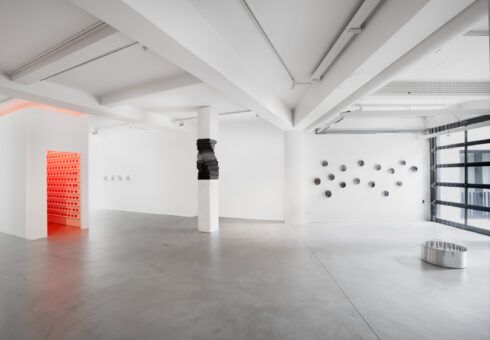
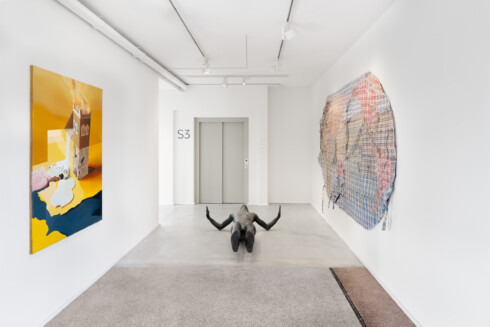
On the final floor, the exhibition reaches its largest scale: having begun with the objects held closest to the body, it arrives at the continents and maps by which the world itself is given form. In Kapwani Kiwanga’s Subduction study #1, rocks from the European and African sides of the Strait of Gibraltar return their political separation to geological time, recalling a world in which today’s continents were joined and anticipating configurations still to come. Dan Halter’s Rifugiato mappa del mondo (China-centric) brings that movement back to human time: migration no longer simply crosses a pre-existing map but reshapes it, as patterns of departure and arrival redraw a world woven from the plastic bags that travel with them.
In Between
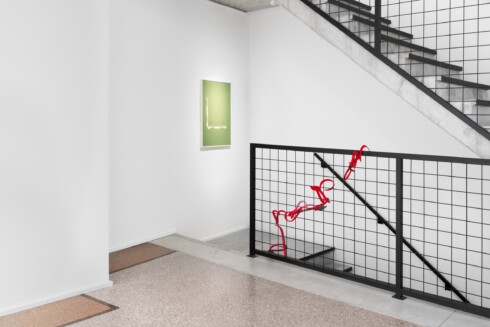
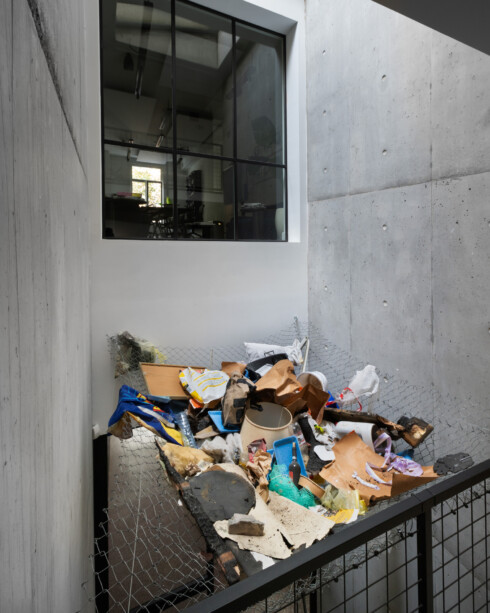
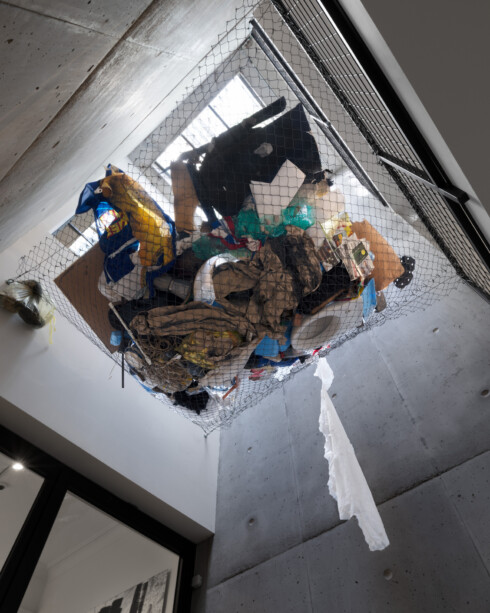
Yet the exhibition does not remain within the floors through which it ascends. Its corridors, staircases and thresholds are occupied by the systems that bind one form of casualty to another. Vera Kox’s Latency brings the polished image of European diplomacy into contact with the steel of Europe’s military economy, while on the staircase Nina Berman’s Make A Killing gives that economy its most casual rhythm: an endless horizontal stream of military contracts awarded on two entirely unremarkable days. Emilio López-Menchero’s H2–H1 cuts across the exhibition’s vertical movement altogether. Based on the nets stretched above Palestinian streets in Hebron H2, where rubbish and everyday objects thrown by settlers accumulate above those passing below, the work hangs between the floors while its debris falls onto the entrance beneath it. The vertical architecture is turned horizontal, under our feet.
Stay in the loop.
Events and exhibitions straight to your inbox.
By clicking send, you will receive occasional emails from Cloud Seven. You always have the choice to unsubscribe.