Casual/Design
A lecture and conversation with art historian Debora L. Silverman on the development of Brussels’ Art Nouveau in the context of Belgian imperialism in the Congo Free State (1885-1909).
Images:
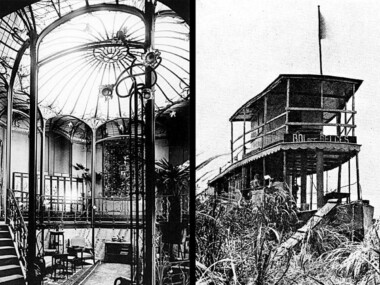
The Winter Garden, Hôtel van Eetvelde (circa 1897).
The steamboat Roi des Belges in the Upper Congo (1889).
Interested to join us ?
RSVPFor Casual/Design, we welcome art historian Debora L. Silverman and artists Aimé Mpané and Jean Pierre Müller for a discussion exploring the connections between art, heritage, and colonial memory. Professor Emerita at UCLA and a member of the American Academy of Arts and Sciences, Debora Silverman is particularly renowned for her pioneering research on the relationship between Belgian Art Nouveau, King Leopold II’s Belgium, and imperialism in the Congo Free State (1885-1908).
Using the example of the Van Eetvelde House, created by Victor Horta for Edmond van Eetvelde, General Administrator and Secretary of State of the Congo Free State, Silverman offers a critical reinterpretation of Belgian Art Nouveau. The lecture shifts attention from architect to patron, showing how this 1897 townhouse operated as an active agent of the imperial culture in which it was embedded. Here policy, financing, and fantasies of a distant empire of extraction took hold. By a close look at the House’s formal design, Silverman’s work highlights unexpected links between aesthetic innovation and imperial domination, inviting us to reconsider this architectural heritage in light of its particular and volatile historical context.
This historical approach enters into dialogue with the work of Aimé Mpané and Jean Pierre Müller, whose piece Dis/Honor is presented at Cloud Seven in Casual/Tease. Originating from their permanent installation Re/Store at the AfricaMuseum in Tervuren, the work reproduces a text censored following a court decision. Through their artistic practice, Mpané and Müller question the representations inherited from Belgian imperial expansionism and colonization and the mechanisms that determine what can be shown, said, or transmitted about this history.
By combining historical research and contemporary creation, this conversation will reflect on how art and heritage participate in the construction, but also in the questioning, of our collective memory.
Abstract:
The 2023 opening of the Van Eetvelde House by Victor Horta (1895-1897) offers an unusual opportunity to bring to the public layers of a long-overlooked history linking Belgian imperialism and Belgian Art Nouveau. Still understudied, Edmond Van Eetvelde (1852-1925) was King Leopold II’s most loyal and talented associate. As Administrator General of the Congo Free State, he devised the legal sanction of “terres vacantes,” allowing King Leopold II to own the Congo and its precious resources as a personal entrepreneurial entity. Van Eetvelde administered this policy from Brussels, unleashing a system of forced labor and violence for Congolese people while amassing spectacular profits for the king and a web of interlocking concession companies. By 1896, the “red rubber regime” was
in full swing and discussed in the Belgian and international press. Drawing on my extensive research and publications, this lecture shifts the ground from architect to patron. I refocus attention on Horta’s Art Nouveau monument not for its singularity as a modernist masterpiece, but as an active agent of the imperial culture in which it was embedded. I show how Van Eetvelde’s lavish townhouse embodied the Headquarters of The Congo Free State in Belgium, where the forms, meanings, and fantasies of a distant empire of profusion and extraction took hold as policy and collective imaginary.
The lecture proceeds in four parts. First, I describe some distinctive features of The Congo Free State as what I see as a non-settler empire. I go on to discuss aspects of Van Eetvelde’s career, temperament, and mentality as he assumed the roles of both “CEO” and “CFO” of the king’s African enterprise. Part Three looks closely at the origins, specific period, and formal characteristics of the townhouse Van Eetvelde commissioned from Victor Horta in 1895 with an unlimited budget and completed with alacrity in 1897. Required to function as both personal residence and as a large venue for Congo fundraising receptions, Horta’s pioneering structure took shape as a propulsive modern style that came to be known as the “coup de fouet” or “whiplash” style. I trace how Horta’s Van Eetvelde House coheres as a particularly Congo style of spatial design, created from Congo raw materials and inspired by Congo motifs. The last part of my lecture will consider some unexpected parallels with the Leopoldian regime in the current American resurgence of laissez-faire imperialism and global extraction, with some consequences for architecture and the environment and an example related to Belgium and the Tervuren Museum.
Biography:
Debora Silverman is Distinguished Professor Emerita of History and Art History at The University of California, Los Angeles and an Elected Member of the American Academy of Arts and Sciences. Among her books are Selling Culture, Art Nouveau in Fin-de-Siècle France, and Van Gogh and Gauguin. She has published widely on the cultural and art history of Belgian imperialism and on the Tervuren Royal Museum for Central Africa. She contributed essays to Aimé Mpané and Jean Pierre Müller, eds., The Grand Rotunda of the Royal Museum for Central Africa Re/Store; to Style Congo, Heritage and Heresy, CIVA; to Iwan Strauven and Benjamin Zurstrassen, eds., Horta and the Grammar of Art Nouveau; and De Standaard, Congo is ook een Amerikaans schandaal. Her recent article is Architecture as Empire: Monumental Cities the Congo Built in Belgium, e-flux, 2024.
Program:
12:00-18:00 Exhibition visit with the mediators
18:00–19:00 Talk: Debora Silverman with Aimé Mpané and Jean Pierre Müller
“Civilization and Barbarism”: The Van Eetvelde House as Modernist Heart of Darkness
19:00-21:00 Cloud Bar
Free admission. Registration is mandatory.
Stay in the loop.
Events and exhibitions straight to your inbox.
By clicking send, you will receive occasional emails from Cloud Seven. You always have the choice to unsubscribe.